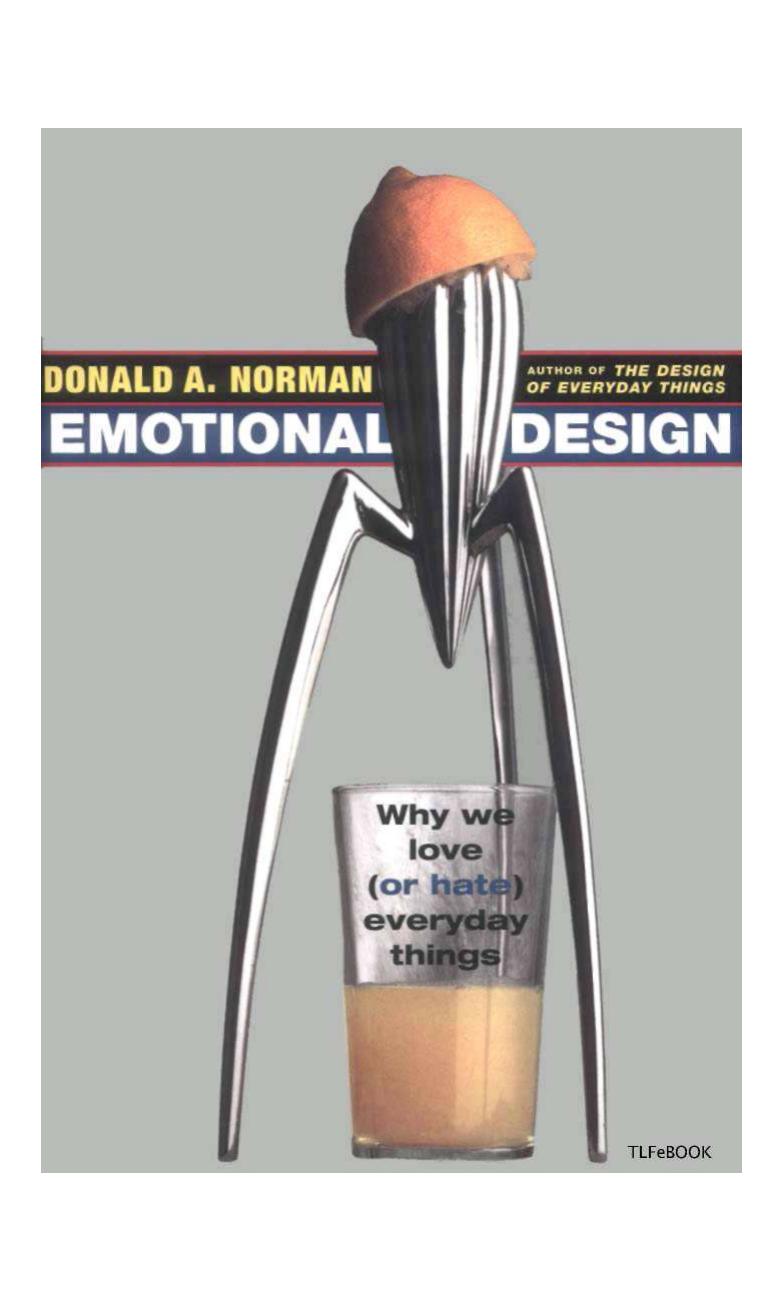
Emotional Design: Why We Love (or Hate) Everyday Things by Donald A. Norman
Author:Donald A. Norman [Norman, Donald A.]
Language: eng
Format: epub, pdf
Published: 2011-05-13T13:40:33+00:00
Video Games
Overslept, woke at 8:00. Only time for a quick coffee before the carpool arrives. The kitchen is disgusting, didn't clean up after last night's little party. Need a bath, but no time (the bathroom's flooded anyway from the broken sink I never got around to fixing). Got to work late and in horrible shape, was demoted as a result. Got home at 5:00, the repo man promptly showed up and repossessed my television because I forgot to pay my bills. My girlfriend won't speak to me because she saw me flirting with the neighbor last night.
Did you realize that this quotation is the description of a game? Not only does it feel like real life, but a bad life at that. Why would anyone think it was a game? Aren't games supposed to be fun? Well, not only is it a description of a game, it is a best-selling one called "The Sims." Will Wright, the designer and inventor of the Sims, explained that this was a typical day in the life of a game character, as developed by a beginning player.
The Sims is an interactive simulated-world game, otherwise known as a "God" game or sometimes "simulated life." The player acts like a god, creating characters, populating their world with houses, appliances, and activities. In this game, the player does not control what the game characters do. Instead, the player can only set up the environ ment and make high-level decisions. The characters control their own lives, although they have to live within the environment and high-level rules established by the player. The result is quite often not at all what their god intended them to do. The quotation is one example of a character unable to cope within the world its god created. But, says Wright, as the player's skill at creating worlds improves, the character might be able to spend the end of each day "sipping mint-juleps by the pool." Wright explains the problem like this:
The Sims is really just a game about life. Most people don't consciously realize how much strategic thinking goes into everyday, minute-to-minute living. We're so used to doing it that it submerges into our subconscious as a background task. But each decision you make (which door to go through? where to eat lunch? when to go to bed?) is calculated at some level to optimize something (time, happiness, comfort). This game takes that internal process and makes it external and visible. One of the first things players usually do in the game is to recreate their family, home, and friends. Then they're playing a game about themselves, sort of a strange, surreal mirror of their own lives.
Play is a common activity, engaged in by many animals and, of course, by us humans. Play serves many purposes. It probably is good practice for many of the skills required later in life. It helps children develop the mix of cooperation and competition required to live effectively in social groups. In animals, play helps establish their social dominance hierarchy.
Download
Emotional Design: Why We Love (or Hate) Everyday Things by Donald A. Norman.pdf
This site does not store any files on its server. We only index and link to content provided by other sites. Please contact the content providers to delete copyright contents if any and email us, we'll remove relevant links or contents immediately.
The Great Music City by Andrea Baker(32609)
Aircraft Design of WWII: A Sketchbook by Lockheed Aircraft Corporation(32333)
Call Me by Your Name by André Aciman(20602)
The Secret History by Donna Tartt(19296)
The Art of Boudoir Photography: How to Create Stunning Photographs of Women by Christa Meola(18688)
Shoot Sexy by Ryan Armbrust(17788)
Plagued by Fire by Paul Hendrickson(17462)
Portrait Mastery in Black & White: Learn the Signature Style of a Legendary Photographer by Tim Kelly(17052)
Adobe Camera Raw For Digital Photographers Only by Rob Sheppard(17031)
Photographically Speaking: A Deeper Look at Creating Stronger Images (Eva Spring's Library) by David duChemin(16735)
Ready Player One by Cline Ernest(14774)
Pimp by Iceberg Slim(14666)
Bombshells: Glamour Girls of a Lifetime by Sullivan Steve(14136)
The Goal (Off-Campus #4) by Elle Kennedy(13780)
Art Nude Photography Explained: How to Photograph and Understand Great Art Nude Images by Simon Walden(13092)
Kathy Andrews Collection by Kathy Andrews(11973)
The Priory of the Orange Tree by Samantha Shannon(9206)
The remains of the day by Kazuo Ishiguro(9085)
Thirteen Reasons Why by Jay Asher(8998)
